
A flat, toned abdomen is the primary goal of any abdominoplasty, yet the true signature of a successful result often lies in the smallest detail. What if the most telling sign of your transformation wasn’t the low-profile incision at your hip, but a “coin-slot” or “sad” navel that looks anything but organic? You’ve likely spent hours researching the procedure, perhaps feeling a mix of excitement for your new silhouette and anxiety about visible circular scarring. It’s a common concern for our Scottsdale and Phoenix patients who want to feel confident in a bikini without the tell-tale signs of surgery.
Discover how expert belly button reconstruction after tummy tuck, or umbilicoplasty, transforms a clinical procedure into a natural-looking aesthetic masterpiece. At MG Plastic Surgery, we prioritize the preservation of your individual features through meticulous surgical planning. This article explains the advanced techniques Dr. Manuel Gigena uses to create a vertically oriented “innie” with hidden scars. With over 25 years of experience and 12,000 procedures performed, Dr. Gigena combines clinical rigor with an artist’s eye to ensure your results look as natural as they feel.
Key Takeaways
- Understand why the belly button must be “re-homed” and how its attachment to the abdominal wall influences your final tummy tuck result.
- Learn how artistic belly button reconstruction after tummy tuck uses internal quilting sutures to create a deep, natural “innie” without visible external tension.
- Discover the “Scottsdale Standard” for navel aesthetics, focusing on a graceful vertical oval shape rather than a telltale horizontal or circular appearance.
- Find out how revision techniques can correct previous surgical outcomes, such as the “coin-slot” or “crater” look, to restore a more organic appearance.
- Explore the importance of choosing a double-board-certified surgeon who views umbilicoplasty as a signature of surgical excellence and patient safety.
The Role of the Umbilicus in a Modern Tummy Tuck
The umbilicus, commonly known as the belly button, serves as the aesthetic anchor of the midsection. It’s a fixed point of attachment where the abdominal skin meets the underlying fascia of the abdominal wall. In a standard Abdominoplasty procedure, this small feature plays a disproportionately large role in the final outcome. While many patients focus on the length of their hip-to-hip incision, the appearance of the navel is often the primary indicator of a high-quality result. A poorly executed navel can look like a “telltale” surgical sign, while a meticulously crafted one creates the illusion of a naturally toned abdomen.
Why Your Belly Button Needs a ‘New Home’
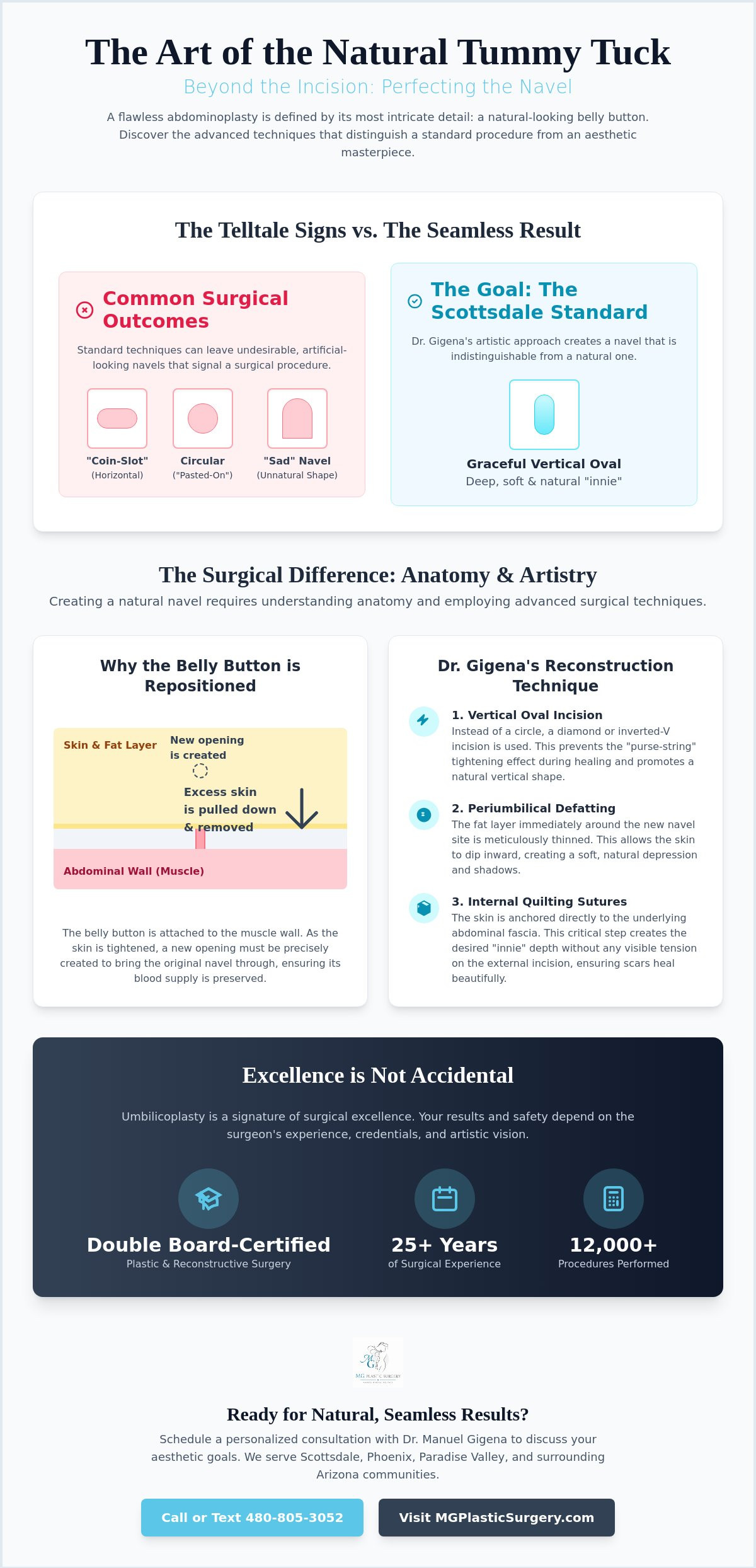
During a tummy tuck, your surgeon addresses skin laxity by redraping the abdominal skin downward toward the pubic area. This process removes the stretched, excess tissue that often accumulates after pregnancy or weight loss. Because the belly button is physically attached to the muscle layer, it stays in its original position while the skin moves around it. To accommodate this shift, the surgeon must create a new opening in the tightened skin and bring the belly button through it. Umbilicoplasty is the surgical reshaping or repositioning of the navel. This step is critical in belly button reconstruction after tummy tuck to ensure the feature looks integrated and organic rather than “pasted on.”
Anatomy of the Umbilical Stalk
The belly button isn’t just a surface feature; it’s supported by a structure called the umbilical stalk. This stalk contains the essential blood supply that keeps the tissue healthy during and after surgery. Maintaining the structural integrity of this stalk is a delicate task, especially when the surgeon is performing muscle repair to treat diastasis recti. Dr. Manuel Gigena’s bio highlights his extensive experience in reconstructive techniques, which is vital for protecting these underlying attachments. In our Scottsdale and Phoenix offices, we emphasize a conservative approach that preserves the stalk’s height and orientation. This careful preservation allows for a more versatile belly button reconstruction after tummy tuck, enabling the creation of a deep, natural “innie” that mirrors a patient’s original anatomy.
- The stalk provides the necessary elevation for a youthful look.
- Proximity to muscle repair requires a surgeon’s steady hand.
- Healthy blood flow prevents common complications like tissue loss or scarring.
Surgical Techniques: Transposition vs. Reconstruction
Many surgeons treat the navel as a secondary step in an abdominoplasty. A simple transposition merely pulls the existing umbilical stalk through a basic circular hole in the redraped skin. This often results in a shallow, “pasted-on” look that lacks the nuanced contours of a natural anatomy. In contrast, premium belly button reconstruction after tummy tuck involves a sophisticated approach to depth, shadow, and transition. It’s about creating a three-dimensional feature that looks as though it was never touched by a scalpel, ensuring the result is an aesthetic masterpiece rather than just a surgical necessity.
Creating the New Opening
The placement of the new opening is a decision of millimeters. A navel set too high can make the torso look unnaturally long, while one set too low disrupts the visual flow of the midsection. Dr. Gigena carefully calculates the perfect vertical height based on your unique proportions and skeletal landmarks. We often move away from traditional circular incisions, which are prone to “purse-string” constriction during healing. Instead, using a diamond or inverted V incision allows the skin to settle into a more organic, vertical oval. This specific geometry ensures the opening remains open and inviting rather than narrowing into a tight, telltale slit over time.
Internal Sculpting and Fixation
True refinement comes from what lies beneath the surface. To achieve a natural transition from the flat abdominal plane into the navel, we perform periumbilical defatting. This involves meticulously thinning the subcutaneous fat layer immediately surrounding the new site. By removing this tiny amount of volume, the skin can dip inward, creating a soft, natural depression. According to this tummy tuck overview from the Mayo Clinic, the procedure is highly individualized, and this internal sculpting is a prime example of that customization.
We then use internal tacking sutures, often referred to as “quilting,” to anchor the skin directly to the underlying abdominal fascia. This technique creates the desired “innie” depth without relying on external tension. Using dissolvable sutures in our Scottsdale clinic further reduces post-operative trauma, as there’s no need for the discomfort of suture removal. This meticulous focus on internal fixation is what allows for a beautiful belly button reconstruction after tummy tuck with minimal visible scarring. If you’re ready to see how these refined techniques can transform your silhouette, you can reach out to our team to begin your personalized consultation.
The Scottsdale Standard: Defining the ‘Natural’ Belly Button
While general medical resources might suggest that navels serve no functional purpose, in the world of high-end body contouring, they’re the focal point of abdominal aesthetics. A truly natural result isn’t a matter of chance; it’s a deliberate pursuit of three specific pillars: Shape, Depth, and Scar Placement. In Scottsdale and Paradise Valley, patients expect a result that doesn’t just look “repaired” but looks inherently organic. This level of belly button reconstruction after tummy tuck requires a departure from generic surgical patterns in favor of a specific aesthetic framework that honors the patient’s original anatomy.
Vertical Orientation and Hooding
A round or horizontal navel is often a telltale sign of previous surgery. In contrast, a vertical orientation creates a slimmer, more youthful abdominal appearance by drawing the eye along the natural midline of the torso. One of the most critical elements of this look is “superior hooding.” This is the subtle fold of skin at the top of the navel that signals a natural “innie.” Many inferior techniques leave the navel looking “surprised” or “wide-open,” which immediately looks artificial. By meticulously crafting this hood, Dr. Gigena ensures the results mirror the soft, shadowed contours found in an unoperated abdomen. Achieving a refined belly button reconstruction after tummy tuck requires this level of artistic nuance to prevent a “coin-slot” appearance.
Scar Concealment Strategies
The most beautiful reconstruction is undermined if the scars are visible on the surface of the skin. To prevent this, we utilize an inverted suture technique that hides the incision line deep within the umbilical bowl. This strategy ensures that even in a bikini, the scar remains invisible to the casual observer. Tension management is equally vital; if the skin is pulled too tightly, the scar can widen and become thick, a condition known as stenosis. Proper post-operative care is essential to maintain these refined results, which is why we provide a comprehensive Tummy Tuck Recovery Checklist to help patients manage their healing process and preserve their aesthetic investment.
Achieving this “Scottsdale Standard” is what separates a standard procedure from a transformative aesthetic experience. If you are seeking a surgeon who values these subtle yet significant details, schedule your consultation with Dr. Gigena today to discuss your personalized treatment plan and begin your journey toward a naturally beautiful result.
Belly Button Revision: Correcting Previous Results
Not every tummy tuck result meets the high aesthetic standards our patients expect. Many individuals in the Phoenix and Scottsdale areas seek our expertise because they’re dissatisfied with the appearance of their navel following a primary surgery performed elsewhere. A “telltale” tummy tuck often centers on a belly button that looks artificial, distorted, or misplaced. Whether the issue is a “Coin Slot,” where the navel has become too narrow and vertical, or “The Crater,” where it appears overly wide and shallow, these concerns can significantly impact self-confidence. We understand the anxiety that comes with a suboptimal result and offer a path toward refinement.
Secondary belly button reconstruction after tummy tuck is a specialized corrective procedure designed to restore a more organic appearance. This process often involves releasing restrictive scar tissue and meticulously reshaping the umbilical bowl to create better depth. Because revision surgery must navigate existing scar tissue and potentially compromised blood supply, it requires a surgeon with a deep understanding of reconstructive principles. Dr. Manuel Gigena uses his extensive experience to evaluate skin elasticity and determine if a secondary umbilicoplasty can achieve the desired “innie” depth and natural transition discussed in earlier sections. A personalized consultation is essential to evaluate your unique anatomy and set realistic revision goals.
When to Consider a Revision
Identifying the right time for a revision is essential for patient safety and surgical success. Signs of a suboptimal result include visible circular scarring around the navel’s edge or a completely “flat” appearance that lacks a natural dip. It’s critical to wait at least 6 to 12 months after your initial procedure before pursuing a revision. This timeline ensures that all internal swelling has subsided and the scar tissue has fully matured. Dr. Gigena draws on his 25 years of experience and over 12,000 procedures to plan these complex corrections, ensuring that the revision strategy is as safe as it is transformative for patients from Paradise Valley to Fountain Hills.
Next Steps for Scottsdale Patients
Your journey toward a more natural-looking result begins with a detailed physical evaluation at MG Plastic Surgery. During this meeting, we’ll discuss your surgical history and your specific aesthetic concerns. We believe in transparency and patient education, which includes providing clear information on Financing Options for elective revision procedures. Our goal is to act as your mentorship-oriented partner, guiding you through the corrective process with calm authority and meticulous care.
To schedule your personalized consultation with Dr. Manuel Gigena in Scottsdale, please call or text 480-805-3052. You may also visit www.MGPlasticSurgery.com and use the “contact” link or the scheduling widget on our website to begin your journey toward a naturally beautiful result.
Refining Your Silhouette with Artistic Precision
A truly transformative tummy tuck is defined by the subtle details that mirror nature. You’ve learned that achieving a deep, vertically oriented “innie” depends on advanced internal sculpting and tension management rather than just skin removal. By prioritizing superior hooding and concealed scar placement, we ensure your results remain your private secret, even in the most revealing swimwear. Whether you are planning your first procedure or seeking a complex revision to correct a “coin-slot” appearance, expert belly button reconstruction after tummy tuck is the key to a result that looks inherently organic.
Dr. Manuel Gigena brings over 25 years of surgical excellence in Arizona and the experience of more than 12,000 procedures to every patient case. As a Double-Board Certified Plastic Surgeon, he combines medical rigor with an artist’s eye to deliver the refined, natural-looking outcomes our patients in Scottsdale and Paradise Valley expect. Your journey toward self-assurance and physical preservation is a collaborative partnership built on trust and clinical excellence.
Take the next step toward your aesthetic masterpiece. Schedule your tummy tuck consultation with Dr. Gigena in Scottsdale today. You can call or text us at 480-805-3052, visit www.MGPlasticSurgery.com via the “contact” link, or use the scheduling widget on our website to begin your transformation. We look forward to helping you achieve a result that feels as natural as it looks.
Frequently Asked Questions
Will my belly button be in the same place after a tummy tuck?
Your belly button remains attached to its original anatomical position on the abdominal wall throughout the procedure. While the surrounding skin is redraped and tightened, the navel itself doesn’t move upward or downward. It’s simply brought through a meticulously planned new opening in the skin to ensure your midsection maintains its natural symmetry.
Is the belly button reconstruction done with my own skin?
Yes, the procedure utilizes your existing umbilical stalk and the surrounding abdominal skin to create a refined result. In cases where a completely new navel is required, Dr. Gigena uses specialized skin flaps from your own abdomen. This ensures that the tissue texture and color match your new silhouette perfectly.
How long does it take for the belly button to heal after surgery?
Initial surface healing typically occurs within two to three weeks, at which point most patients feel comfortable with the appearance of the area. You’ll see the most significant aesthetic changes in the first month as swelling subsides. However, the internal tissues and scars continue to mature for six to twelve months before reaching their final, soft state.
What happens if I have an umbilical hernia during my tummy tuck?
Dr. Gigena can often repair an umbilical hernia concurrently with your abdominoplasty. This combined approach addresses the underlying muscle weakness while performing the belly button reconstruction after tummy tuck. It’s a highly efficient way to achieve both functional health and an aesthetic masterpiece in a single surgical session at our Scottsdale facility.
Can a belly button revision be done under local anesthesia?
Minor adjustments to the shape or scar placement of the navel can often be performed using local anesthesia with light sedation. This approach is suitable for patients seeking small refinements to a previous result. For more complex reconstructions that require deeper tissue work, a more comprehensive level of anesthesia may be recommended to ensure your total comfort.
Will there be a visible scar around my new belly button?
While every surgical incision results in a scar, we prioritize hiding the incision line deep within the umbilical bowl. By placing the scar inside the navel, the natural shadows of the “innie” shape conceal the mark from view. This meticulous technique ensures your belly button reconstruction after tummy tuck looks organic and remains your private secret.

Article by
Dr. Manuel Gigena, MD, FACS
Dr. Manuel Gigena, MD, FACS is a Double-Board Certified Plastic & Reconstructive Surgeon and Founder of MG Plastic Surgery in Scottsdale, Arizona. With more than 25 years of experience and over 12,000 procedures performed, he specializes in breast surgery (breast augmentation and breast reduction), body contouring, fat transfers, facial rejuvenation, and advanced aesthetic treatments.
Disclaimer
The information provided in this article is for educational and informational purposes only and is not intended as medical advice. Content may be generated or assisted by artificial intelligence and reviewed for general accuracy but should not replace a consultation with a qualified healthcare professional.
Individual results and treatment options may vary. Always consult with a board-certified plastic surgeon or licensed medical provider before making decisions regarding cosmetic or medical treatments.
MG Plastic Surgery makes no guarantees regarding outcomes and assumes no liability for actions taken based on this content.