
The journey of motherhood is transformative, a profound shift in identity, priority, and physiology. For mothers of twins, this transformation is often magnified. Carrying two babies places extraordinary demands on the body, leading to changes that can feel overwhelming and, at times, permanent. You have given your body to create life, and now, as you navigate the beautiful chaos of raising multiples, you may look in the mirror and not fully recognize the person looking back. This feeling is valid, and you are not alone.
In Scottsdale, a culture of vitality and wellness meets the realities of post-pregnancy life. Many mothers find that despite their best efforts with diet and exercise, the lingering effects of a twin pregnancy—stretched skin, separated abdominal muscles, and changes in breast shape—remain. This is not a failure of effort; it is a matter of biology.
This guide is for the Scottsdale mother of twins who is ready to explore a path back to herself. It’s a professional roadmap to understanding the unique physiological impact of a multiple pregnancy and discovering the expert surgical solutions available to restore your form, function, and confidence. Led by the expertise of Dr. Manuel Gigena, a world-renowned, double-board-certified plastic surgeon, this is your guide to postpartum restoration.
The Physiological Impact of a Twin Pregnancy on Your Body
A twin pregnancy is a remarkable feat of nature, but it subjects the body to stresses far beyond those of a singleton pregnancy. The abdominal wall and skin undergo what can be described as a “double stretch,” expanding to a degree that often pushes tissues past their natural point of recovery. Understanding these specific changes is the first step toward addressing them.
- Extreme Tissue Stretch: The sheer volume required to house two babies causes an accelerated and extensive stretching of the abdominal skin and underlying muscles. This extreme distension often damages the skin’s elastin and collagen fibers, making it difficult for the skin to “snap back” into place after delivery.
- Severe Diastasis Recti: Diastasis recti, the separation of the rectus abdominis muscles, is common in most pregnancies. However, in twin pregnancies, the separation is frequently more severe. The connective tissue (linea alba) that holds these muscles together can be stretched so thin that it loses its integrity, resulting in a persistent “pooch” and weakened core.
- Accelerated Breast Volume Loss: The hormonal changes of pregnancy, combined with the demands of nursing two infants, can lead to a significant loss of breast volume and elasticity. After weaning, many mothers of twins notice a “deflated” or sagging appearance as glandular tissue recedes, leaving behind stretched skin.
- Compromised Core Function: Beyond aesthetics, the profound stretching of the core muscles can lead to functional issues, including chronic lower back pain, poor posture, and pelvic floor instability.
Understanding Diastasis Recti in Multiples
The “twin pooch” that many mothers experience is often a direct result of severe diastasis recti. As the uterus expands to accommodate two growing babies, the linea alba thins and stretches, sometimes to its breaking point. This creates a wide, persistent gap between the two sides of your “six-pack” muscles. After birth, this gap doesn’t always close on its own. Critically, traditional abdominal exercises like crunches can actually worsen the condition by increasing intra-abdominal pressure and pushing organs out through the weakened tissue, making the bulge more pronounced.
The “Deflation” Effect: Post-Nursing Breast Changes
After a twin pregnancy and nursing journey, the breasts undergo a rapid involution process. The milk-producing glandular tissue shrinks, but the skin envelope that expanded to accommodate it often does not. This results in ptosis (sagging) and a loss of upper-pole fullness. While a mother of a singleton may require either a breast lift or an augmentation, a mother of twins often needs a combination approach—a mastopexy (lift) to reposition the breast and remove excess skin, and an augmentation to restore lost volume. This “lift and fill” technique is designed to create a youthful, natural-looking profile that is proportional to your frame.
When Diet and Exercise Aren’t Enough: Identifying the Limits of Natural Recovery
For months, or even years, you may have dedicated yourself to a regimen of clean eating and consistent workouts, only to feel frustrated by the reflection in the mirror. It is crucial to understand the clinical difference between stubborn fat and the permanent tissue changes caused by a twin pregnancy. Diet and exercise can reduce subcutaneous fat, but they cannot tighten loose, overstretched skin or surgically repair separated abdominal muscles.
- Subcutaneous Fat vs. Redundant Skin: While a healthy lifestyle can shrink fat cells, it has no effect on excess skin left behind after extreme stretching. Once the elastin fibers have snapped, the skin loses its ability to retract fully.
- The Role of Genetics and Age: Your individual capacity for skin “snap-back” is largely determined by genetics, age, and overall skin quality. For many women, especially after the significant distension of a twin pregnancy, the skin’s biological limit has been reached.
- “The Shelf” After a C-Section: A C-section, common in twin births, can create an additional challenge. The incision can tether the skin, causing a fold of loose skin and tissue to hang over the scar, often referred to as “the shelf.” No amount of exercise can correct this.
- A Functional Necessity: For many mothers of twins, surgical intervention is not merely cosmetic. Repairing a severe diastasis recti is a functional necessity to restore core stability, alleviate back pain, and improve overall physical well-being.
The Myth of “Toning” Loose Skin
The fitness industry often promotes the idea that you can “tone” or “tighten” loose skin with specific exercises or creams. Biologically, this is not possible. Skin is an organ; its elasticity depends on the integrity of its collagen and elastin fibers. When these fibers are stretched beyond their capacity—as they frequently are with twins—they break. A simple self-check can help you identify permanent skin laxity: if you can pinch and pull the skin away from the underlying muscle with little resistance, it is likely redundant skin that will not respond to workouts.
Functional Benefits of Postpartum Restoration
Restoring your body after a twin pregnancy is about more than just aesthetics; it’s about reclaiming your physical strength and comfort. A tummy tuck with muscle repair (abdominoplasty) does more than create a flat abdomen. By suturing the separated rectus abdominis muscles back together, the procedure rebuilds the “internal corset” of your core. This has profound functional benefits, including:
- Alleviation of Chronic Lower Back Pain: A strong abdominal wall provides essential support for the spine, often significantly reducing or eliminating the chronic back pain that plagues many postpartum women.
- Improved Posture and Pelvic Health: A repaired core helps you stand taller and can improve pelvic floor function, contributing to better bladder control and overall stability.
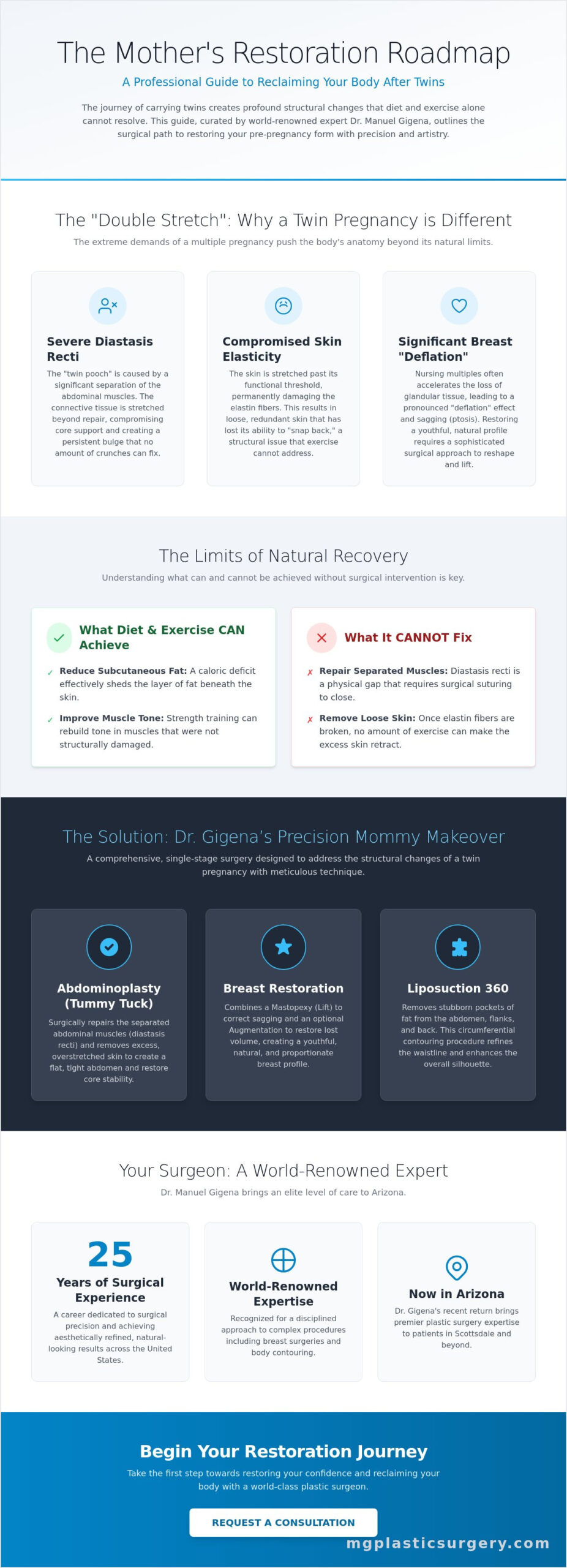
The Scottsdale Mommy Makeover: Dr. Gigena’s Precision Approach for Twin Moms
When you are ready to move beyond the limitations of natural recovery, choosing the right surgeon is the most important decision you will make. Dr. Manuel Gigena is a double-board-certified plastic surgeon whose reputation is built on 25 years of world-renowned surgical excellence. Having operated across the United States, his recent return to Arizona brings an unparalleled level of expertise and precision to the Scottsdale community.
A Mommy Makeover is not a one-size-fits-all procedure, especially for a body that has carried twins. It is a highly personalized combination of surgeries designed to address your specific areas of concern. Dr. Gigena’s comprehensive approach typically integrates three core components:
- Abdominoplasty (Tummy Tuck): To remove excess skin and repair separated abdominal muscles.
- Mastopexy (Breast Lift): With or without augmentation to restore a youthful breast shape and position.
- Liposuction 360: To sculpt the waist, flanks, and back for a harmonious, defined silhouette.
Choosing a surgeon with Dr. Gigena’s credentials is paramount for a complex, multi-procedure surgery like a Mommy Makeover. His meticulous technique and deep understanding of post-pregnancy anatomy ensure results that are not only beautiful but also safe and natural-looking.
Tailoring the Tummy Tuck for Profound Postpartum Changes
The tummy tuck required after a twin pregnancy is often more complex than a standard procedure. Dr. Gigena utilizes advanced muscle plication techniques to close even the widest gaps in the rectus abdominis, creating a durable and powerful repair. This is frequently combined with Liposuction 360, which treats the torso as a complete unit. By contouring the waist, hips, and back, he sculpts an hourglass figure that beautifully complements the newly flattened abdomen. This 360-degree approach ensures a balanced and transformative result. Learn more about the procedure in our Scottsdale Tummy Tuck guide.
Restoring Volume: Breast Augmentation and Lifts
For mothers of twins, restoring the breasts often requires a dual approach. A Mastopexy-Augmentation, or “lift and fill,” addresses both sagging and volume loss in a single surgery. Dr. Gigena’s philosophy is centered on achieving a refined, natural-looking result that honors your body’s proportions and aligns with the sophisticated Scottsdale aesthetic. He works closely with each patient to select the ideal implant size, shape, and profile to achieve their desired outcome, ensuring the final result enhances their figure without appearing artificial. Discover what makes an expert in our guide to choosing the best plastic surgeon in Scottsdale for breast augmentation.
Navigating Your Recovery and Results in Scottsdale
The thought of recovering from major surgery while caring for twin toddlers can be daunting, but with proper planning, it is entirely manageable. Dr. Gigena and his team provide a comprehensive recovery plan tailored to the unique challenges of a busy mother’s life.
- The “No Lifting” Rule: The most critical phase of recovery is the first 2 weeks, during which you must adhere to a strict “no lifting” rule (nothing over 10 pounds). This is essential for protecting your muscle repair and incisions.
- Luxury Recovery Environment: Scottsdale and Paradise Valley offer numerous options for a comfortable and supportive recovery, from private nursing services to luxury accommodations where you can rest and heal peacefully.
- Return to Your Lifestyle: While the initial recovery requires downtime, you can typically expect to return to light daily activities within 2-3 weeks and be back to enjoying the Scottsdale social and fitness scene within 6-8 weeks, with final results continuing to refine over several months.
- Preserving Your Investment: Maintaining a stable weight and healthy lifestyle is key to enjoying your surgical results for years to come.
Logistics for the Busy Phoenix Mother
Success in recovery is rooted in preparation. We strongly advise patients to arrange for dedicated childcare and home support, especially for the first 10-14 days. This may mean leaning on your partner, family, or hiring professional help. Having a support system in place allows you to focus completely on healing, which ultimately leads to a faster, smoother recovery and better results. Our team is here to help you plan the logistics and can provide resources to make your journey accessible. To help manage the financial aspect of your transformation, we invite you to explore financing options for your restoration journey.
Safety and Quality Checklist for 2026
Your safety is the absolute highest priority. Dr. Gigena performs all surgical procedures in a fully accredited, state-of-the-art surgical facility that meets the most rigorous standards for safety, cleanliness, and technology. Anesthesia is administered by a board-certified anesthesiologist to ensure your comfort and well-being throughout the procedure. We encourage all patients to be proactive in their safety by reviewing our comprehensive 2026 Patient Safety & Quality Checklist.
Frequently Asked Questions
How long should I wait after having twins before getting a Mommy Makeover?
We recommend waiting at least 6 to 12 months after giving birth before considering surgery. This allows your body to fully heal from pregnancy and delivery, for your weight to stabilize, and for you to finish breastfeeding. This waiting period ensures that we are operating on a stable canvas for the most predictable and lasting results.
Can Dr. Gigena fix severe diastasis recti caused by a twin pregnancy?
Absolutely. Dr. Gigena specializes in complex abdominal wall reconstruction. He uses advanced surgical techniques to repair even very wide separations of the rectus muscles, effectively restoring the integrity and strength of the core, which is often severely compromised after carrying twins.
Will I have visible scars after my post-twin body restoration?
Yes, any surgical procedure will result in scars. However, Dr. Gigena is meticulous about scar placement. The tummy tuck incision is placed very low on the abdomen, easily concealed by underwear or a bikini bottom. Breast incisions are strategically placed around the areola, vertically down the breast, or in the breast crease to be as discreet as possible. With proper scar care, these incisions fade significantly over time.
Is it possible to have more children after getting my body back surgically?
While it is physically possible to have another pregnancy after a Mommy Makeover, we strongly advise patients to wait until they are certain they are finished having children. A future pregnancy would re-stretch the skin and abdominal muscles, potentially compromising your surgical results and requiring revision surgery.
How do I manage twin toddlers during my recovery period in Scottsdale?
This is a critical logistical consideration. For the first two weeks, you will be unable to lift your toddlers. It is essential to have a dedicated support system in place—whether it’s your partner, a family member, or a hired caregiver—to handle all childcare duties, including lifting, bathing, and playing. Planning for this support is the key to a stress-free and successful recovery.
Disclaimer
The information provided in this article is for educational and informational purposes only and is not intended as medical advice. Content may be generated or assisted by artificial intelligence and reviewed for general accuracy but should not replace a consultation with a qualified healthcare professional.
Individual results and treatment options may vary. Always consult with a board-certified plastic surgeon or licensed medical provider before making decisions regarding cosmetic or medical treatments.
MG Plastic Surgery makes no guarantees regarding outcomes and assumes no liability for actions taken based on this content.