
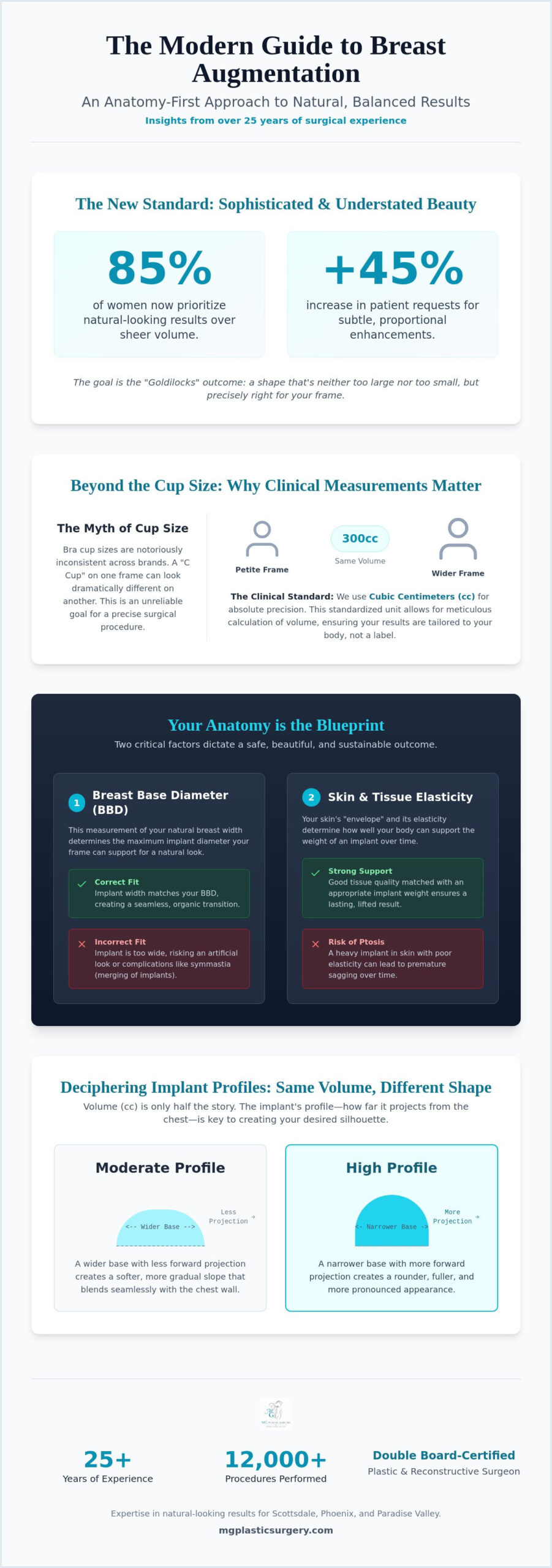
Did you know that 85% of women now prioritize natural-looking results over sheer volume? Recent data from Madison Plastic Surgery shows a 45% increase in requests for subtle enhancements, reflecting a shift toward sophisticated, understated beauty. If you’ve found yourself confused by inconsistent bra sizing or worried that your implants might feel too heavy for your tissue, you aren’t alone. Most patients seek that perfect “Goldilocks” outcome; a shape that’s neither too large nor too small, but precisely right for their frame. Choosing implant size and profile is a meticulous process that balances your personal aesthetic goals with the unique physical boundaries of your anatomy.
This guide will help you master the clinical factors required to achieve a refined silhouette that complements your lifestyle. Dr. Manuel Gigena, a Double-Board Certified surgeon with over 25 years of experience, views this selection as a geometric partnership between your chest wall width and skin elasticity. We’ll preview how different profiles affect your projection and why a tailored surgical plan is the foundation for lasting confidence. You’ll learn how to move past the “cup size” myth to find a balanced, youthful look that feels natural in Scottsdale’s active environment.
Key Takeaways
- Move beyond the inconsistency of bra manufacturers by understanding how cubic centimeters (cc) provide a precise, clinical measurement for your desired volume.
- Learn why your chest wall width and tissue elasticity are the most critical anatomical constraints in achieving a safe and sustainable result.
- Gain clarity on choosing implant size and profile by identifying the differences between moderate and high-projection designs for your specific frame.
- Explore the practical visualization tools, such as the “Rice Test” and physical sizers, used during a personalized Scottsdale consultation to preview your silhouette.
- Discover how an “anatomy-first” approach prioritizes long-term breast health and a refined, natural look that fits your active Arizona lifestyle.
Beyond the Cup Size: Understanding Volume (cc) and Projection
While many patients arrive at our Scottsdale practice with a specific bra cup size in mind, this metric is notoriously inconsistent across different lingerie brands. In clinical settings, we measure volume in cubic centimeters (cc) to provide absolute precision. This standardized unit allows for a meticulous calculation that bra sizes simply can’t match. However, volume is merely one piece of the puzzle. The way that volume interacts with your unique frame depends entirely on projection; the distance the implant extends forward from the chest wall. Volume alone doesn’t determine your final aesthetic outcome; rather, it’s the synergy between that volume and the implant’s specific dimensions that creates a balanced look.
The Limitations of Cup Size Goals
A “C cup” is not a universal constant. On a petite frame in Paradise Valley, a 300cc implant might create a very full appearance, while the same volume on a wider frame in Phoenix could look remarkably subtle. Your existing breast tissue also acts as a foundation. If you already have significant natural volume, a smaller implant may be all that’s required to achieve your goal. Transitioning your mindset from a specific cup size to an overall silhouette allows Dr. Manuel Gigena to design a plan that prioritizes your individual anatomy over a label.
Why cc Volume is Only Half the Story
When choosing implant size and profile, you must consider the “footprint” of the device. A 300cc implant can be manufactured with a wide base and low projection or a narrow base and high projection. If the implant’s diameter exceeds your natural breast base, the result often looks unnatural or “bolted on.” During a Breast augmentation procedure, matching the implant’s footprint to your chest wall width is essential for a seamless transition. Natural-looking results require a strategic balance; ensuring the implant fits within your anatomical boundaries while providing the desired lift and shape. This careful planning prevents the “heavy” look many patients fear and ensures your results complement an active Arizona lifestyle.
Anatomy-First Selection: Why Your Frame Dictates the Fit
While volume is a personal preference, your anatomy acts as the definitive blueprint for what is surgically achievable. The chest wall width is the primary physical constraint for any implant diameter. If an implant is too wide for your frame, it can compromise the natural inter-mammary spread, leading to a crowded or artificial appearance. Dr. Manuel Gigena utilizes his 25 years of surgical experience and insights from over 12,000 procedures to assess these variables during your initial consultation in Scottsdale. By prioritizing your bone structure and existing tissue, he ensures that the enhancement feels like an organic part of your body.
Measuring the Breast Base Diameter (BBD)
The Breast Base Diameter (BBD) is the foundation of your surgical plan. This measurement determines the maximum width an implant can have without crossing into the center of the chest or extending too far into the underarm area. Selecting an implant wider than your BBD increases the risk of symmastia, a rare complication where the implants merge across the midline. When choosing implant size and profile, staying within your natural borders ensures that the results appear as an extension of your body rather than a heavy addition. According to the American Society of Plastic Surgeons, choosing the right implant size is deeply rooted in these proportional measurements. The best implant is one that stays within your natural borders while providing the lift you desire.
Tissue Quality and Long-Term Support
Your skin’s envelope capacity is just as vital as the bone structure beneath it. Tissue elasticity determines how well your body can support the weight of an implant over time. For active residents in Cave Creek or Carefree, a heavier implant may lead to premature sagging, or ptosis, due to the constant impact of high-intensity movement. Dr. Gigena carefully assesses skin laxity to ensure the chosen volume doesn’t overwhelm the available support. In Dr. Manuel Gigena’s bio, his commitment to safety and long-term aesthetic stability is evident through his meticulous planning process. If you’re curious about how your specific measurements might influence your options, you can start a conversation with our clinical team to explore the possibilities for your silhouette.
Deciphering Profiles: Moderate vs. High Projection
An implant’s profile describes its side-view projection relative to its base width. This geometric ratio is the secret to ensuring your results look balanced from every angle. As the FDA guide to breast implants explains, these devices vary significantly in shape and projection to accommodate diverse body types. When choosing implant size and profile, the goal is to align the geometry of the device with the specific dimensions of your torso. A profile that is too low may look flat, while one that is too high for a wide frame can appear unnatural.
Moderate and Moderate Plus: The ‘Natural’ Choice?
Moderate profiles feature a wider footprint and a more gradual, sloping curve. These are frequently the ideal choice for women in Phoenix or Paradise Valley with wider chest walls who desire a look that mimics the natural, teardrop spread of breast tissue. Because the volume is distributed across a larger surface area, moderate profiles provide a very subtle transition from the upper chest to the breast. This profile works exceptionally well for patients who already have some natural volume and simply want to enhance their existing shape with a refined, understated silhouette.
High Profile: Projection for Narrow Frames
If you have a narrow torso but want significant volume, a high profile is often an anatomical necessity. These implants have a smaller base width but extend further forward. This design allows women with petite frames to achieve their volume goals without the implant overextending past the rib cage or into the underarm area. High profiles are also excellent for achieving “upper pole fullness,” which creates a youthful roundness in the top half of the breast. While some competitors claim high profiles always look artificial, Dr. Manuel Gigena uses them strategically to create a balanced silhouette for patients whose horizontal space is limited.
For those requiring maximum projection or specific reconstructive outcomes, ultra-high profiles are also available. These are specialized tools used to create a more dramatic silhouette or to address significant tissue laxity. Dr. Gigena’s 25 years of experience ensures that regardless of the profile chosen, the result remains sophisticated and secure. With over 12,000 procedures performed, he understands how profile choice impacts your long-term satisfaction and physical comfort. Schedule your personalized profile assessment at our Scottsdale office to see which design fits your frame.
The MG Plastic Surgery Approach: Planning Your Transformation
Achieving a refined result requires moving beyond simple measurements and into the realm of meticulous clinical planning. At MG Plastic Surgery, the process of choosing implant size and profile is treated as a sophisticated medical journey rather than a transactional choice. Dr. Manuel Gigena, a Double-Board Certified Plastic & Reconstructive Surgeon with over 25 years of experience and more than 12,000 procedures performed, utilizes a tripartite philosophy centered on preparation, security, and long-term care. This disciplined approach ensures that your transformation is not only beautiful today but remains stable and healthy for years to come.
The Consultation: A Collaborative Partnership
Your initial appointment in our Scottsdale office is an educational experience where your aesthetic aspirations meet surgical reality. We encourage you to bring goal photos that illustrate your ideal silhouette; these serve as a vital communication tool to help Dr. Gigena understand your preferences for cleavage and upper pole fullness. Beyond the visual, we evaluate your specific lifestyle needs. Whether you’re active in the fitness communities of North Scottsdale or enjoy the social atmosphere of Paradise Valley, your daily routine influences the weight and projection that will best suit your frame. To help you manage the investment in your self-assurance, our team can discuss financing options during this collaborative session.
Trialing Your Size: Sizers and Visualization
To bridge the gap between imagination and reality, we employ advanced visualization tools, including physical sizers and 3D imaging. External sizers are particularly effective; they allow you to feel the weight of different volumes and see how various profiles interact with your favorite clothing. We also discuss the “Rice Test” as a practical home visualization method to help you live with a prospective size before making a final commitment. While these tools provide an excellent blueprint, Dr. Gigena’s clinical expertise is paramount. He may make a final adjustment during the procedure to ensure the implant footprint aligns perfectly with your anatomy for the most natural-looking results.
This commitment to excellence and patient security is what defines our practice. We view every procedure as a life-enhancing progression that deserves the highest standards of medical rigor and boutique-level care. By choosing a surgeon who prioritizes anatomical harmony, you’re investing in a look that preserves your identity while enhancing your confidence.
To schedule a consultation with Dr. Manuel Gigena, MD, FACS at MG Plastic Surgery in Scottsdale, please call or text 480-805-3052. You can also visit www.MGPlasticSurgery.com via the “contact” link or use the scheduling widget on our website to begin your personalized journey toward a balanced, refined silhouette.
Your Path to a Refined Silhouette
Selecting the right enhancement isn’t about chasing a label; it’s about honoring the natural proportions of your body. We’ve explored how cubic centimeters and projection profiles work together to create a look that feels organic. By prioritizing your chest wall width and tissue elasticity, you ensure a result that supports your active Arizona lifestyle. Choosing implant size and profile is the most critical step in your transformation, requiring the guidance of a surgeon who values preservation over exaggeration.
Dr. Manuel Gigena, a Double-Board Certified Plastic Surgeon with over 25 years of surgical experience and more than 12,000 procedures performed, provides the meticulous planning needed for these refined outcomes. Whether you’re in Paradise Valley or Fountain Hills, your journey toward self-assurance starts with a collaborative partnership. Ready to find your perfect fit? Schedule a consultation with Dr. Manuel Gigena at MG Plastic Surgery in Scottsdale. You can call or text 480-805-3052, visit www.MGPlasticSurgery.com via the “contact” link, or use our website’s scheduling widget to begin your personalized transformation today. We look forward to helping you achieve a look that feels uniquely yours.
Frequently Asked Questions
How many ccs are in one cup size?
Roughly 150 to 200cc typically equals one cup size, though this is a general estimate rather than a clinical rule. Because bra manufacturers don’t use standardized sizing, a “C cup” in one brand might be a “D cup” in another. Your existing breast tissue and chest wall width also influence how much volume is needed to move up a size. We focus on your overall silhouette rather than a specific label.
Will high profile implants make me look ‘fake’?
High profile implants won’t look artificial if they’re matched to a narrow chest wall. Many patients believe high projection always equals a “bolted-on” look, but for women with petite frames, it’s often the only way to achieve volume without the implant overextending past the ribs. Choosing implant size and profile correctly ensures the projection looks balanced and refined, rather than exaggerated or misplaced on your torso.
Can I choose my size based on my friend’s results?
You shouldn’t select your size based on someone else’s results because every anatomical foundation is unique. Your friend’s 350cc implants might look entirely different on you if you have more natural tissue or a wider breast base. Dr. Gigena evaluates your specific bone structure and skin elasticity to determine what will look natural for your frame. Using sizers during your consultation is a much more reliable way to preview your own transformation.
Does the profile affect the cost of breast augmentation in Scottsdale?
The implant profile itself generally doesn’t change the base price of your procedure. In Scottsdale, the cost of breast augmentation is more likely influenced by the type of implant material, such as silicone versus saline, and whether you require additional techniques like a breast lift. While choosing implant size and profile is a vital part of the surgical plan, it’s usually included as part of your personalized treatment strategy during the consultation process.
What happens if I choose an implant that is too large for my frame?
Selecting an implant that exceeds your frame’s capacity can lead to long-term complications like tissue thinning or premature sagging. When the weight is too heavy for your skin’s envelope, the results may drop lower than desired over time. Oversized implants also increase the risk of symmastia, where the breasts merge at the midline. We prioritize safety by ensuring your chosen volume remains within the healthy boundaries of your natural anatomy.
How does my activity level affect my choice of implant size?
Your lifestyle plays a significant role in determining the right volume and projection for your needs. Athletes or very active residents in Scottsdale often prefer smaller, lighter implants to avoid physical discomfort during high-impact movement. Heavier implants can cause strain on the back and shoulders or lead to faster tissue stretching during exercise. We work with you to ensure your enhancement complements your fitness routine rather than hindering it.
Article by
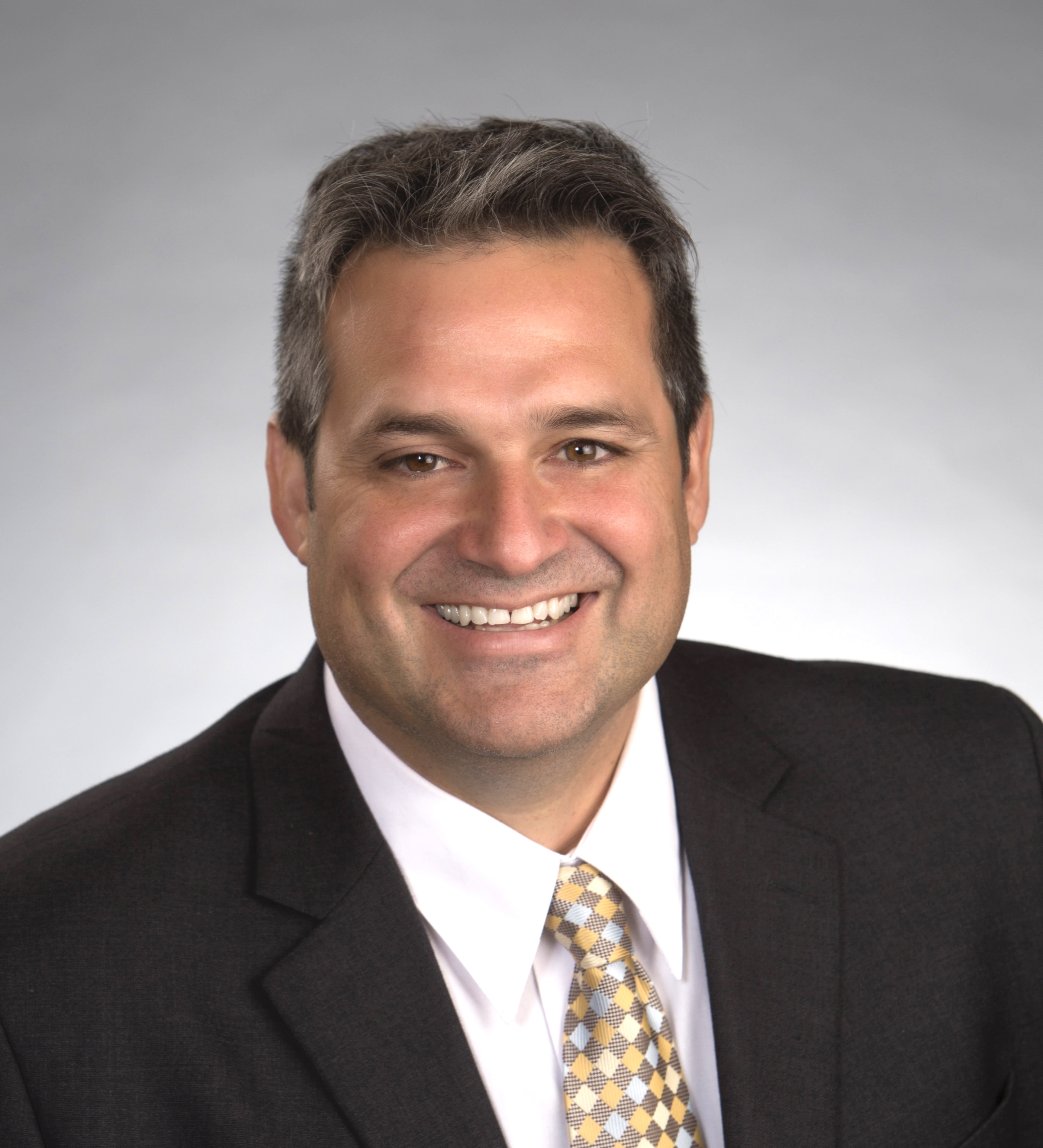
Dr. Manuel Gigena, MD, FACS
Dr. Manuel Gigena, MD, FACS is a Double-Board Certified Plastic & Reconstructive Surgeon and Founder of MG Plastic Surgery in Scottsdale, Arizona. With more than 25 years of experience and over 12,000 procedures performed, he specializes in breast surgery (breast augmentation and breast reduction), body contouring, fat transfers, facial rejuvenation, and advanced aesthetic treatments.
Disclaimer
The information provided in this article is for educational and informational purposes only and is not intended as medical advice. Content may be generated or assisted by artificial intelligence and reviewed for general accuracy but should not replace a consultation with a qualified healthcare professional.
Individual results and treatment options may vary. Always consult with a board-certified plastic surgeon or licensed medical provider before making decisions regarding cosmetic or medical treatments.
MG Plastic Surgery makes no guarantees regarding outcomes and assumes no liability for actions taken based on this content.