
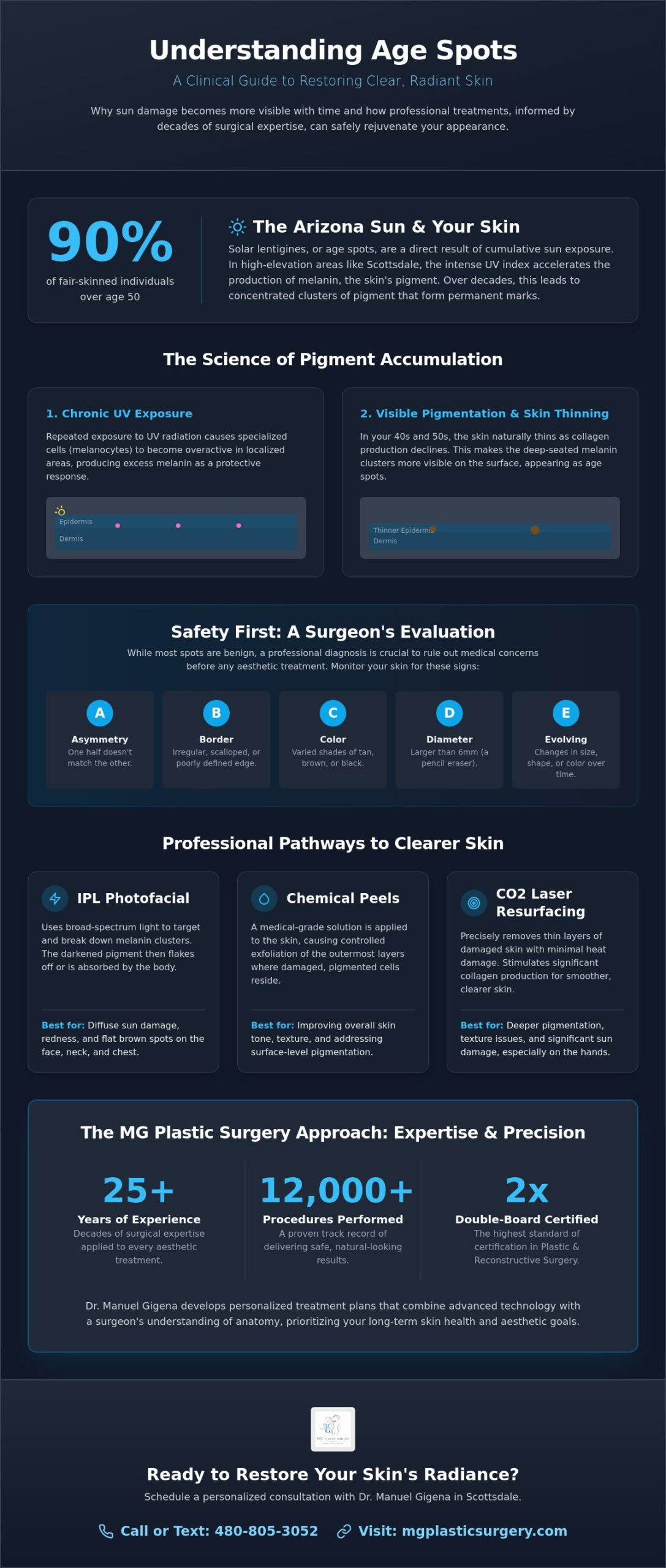
More than 90% of individuals with fair skin over the age of 50 develop solar lentigines, commonly known as age spots. While these marks often result from years spent enjoying the vibrant Arizona sun, they can create a frustrating disconnect between your inner vitality and your outward appearance. It’s common to feel that these patches of pigment make you look older than you feel, especially when high-end department store creams fail to provide the clarity they promise. Beyond aesthetics, we understand the quiet anxiety that comes with monitoring new changes in your skin and the deep desire for the peace of mind that comes from professional medical validation.
You deserve a complexion that reflects your health and your history without the clutter of sun damage. This guide provides a clinical perspective on why these spots form and outlines the most effective professional pathways to restore an even, radiant skin tone. We will explore how Dr. Manuel Gigena combines 25 years of surgical precision with advanced aesthetic treatments to achieve natural-looking rejuvenation for patients across Scottsdale, Phoenix, and Paradise Valley. From medical-grade peels to innovative light-based protocols, you’ll discover how we prioritize your safety and long-term skin health to ensure you feel as youthful as you look.
Key Takeaways
- Learn why high-desert UV intensity in Scottsdale accelerates the development of age spots and how to distinguish these marks from other skin concerns.
- Understand the biological shifts that occur in your 40s and 50s, making cumulative sun damage more visible as the skin naturally thins over time.
- Compare the clinical efficacy of professional treatments like IPL Photofacials and chemical peels for restoring a clear, uniform skin tone.
- Discover how Dr. Gigena’s 25 years of surgical expertise informs a personalized approach to skin restoration that prioritizes natural-looking results.
- Explore why a customized, medical-grade skincare protocol is essential for preserving your clinical outcomes and ensuring long-term skin health.
Understanding Age Spots: What Are Solar Lentigines?
In the high-desert landscape of Scottsdale and Paradise Valley, the sun is a constant companion. While our climate is enviable, it presents a unique challenge for skin preservation. Age spots, technically known as solar lentigines, are flat areas of increased pigmentation that appear as brown, gray, or black spots on the skin. Unlike freckles, which often emerge in childhood and fade during the winter months, age spots are permanent fixtures that do not diminish when sun exposure decreases. They represent the skin’s long-term memory of UV radiation, serving as a visible record of cumulative exposure rather than a recent tan.
Living in Arizona introduces what we call the Scottsdale Factor. The intense UV index at our elevation accelerates the production of melanin, the pigment that gives skin its color. When the skin is subjected to years of high-intensity light, melanin can clump together or be produced in high concentrations, leading to the formation of these distinct marks. A deeper look into Understanding Solar Lentigines reveals that these clusters are the result of localized melanocyte proliferation. It is a common misconception that these are related to internal health; the term liver spot is a historical misnomer, as these marks have no physiological connection to liver function.
The Anatomy of Pigmentation
Your skin contains specialized cells called melanocytes. Their primary role is to produce pigment to protect deeper layers of tissue from UV damage. Over time, chronic exposure causes these cells to become hyperactive in specific areas. This overproduction typically occurs on the face, the backs of the hands, and the shoulders, which are the regions most frequently kissed by the sun. As the skin naturally thins in our 40s and 50s, this underlying pigment becomes more pronounced and visible at the surface.
Safety First: When a Spot Requires a Surgeon’s Eye
While most pigmented marks are benign, distinguishing between a harmless spot and a medical concern is vital for residents of Phoenix and Carefree. We encourage patients to monitor their skin using the ABCDE criteria: Asymmetry, Border irregularity, Color variation, Diameter, and Evolving shape. Before beginning any aesthetic laser therapy or chemical peel, a professional diagnosis is essential to rule out actinic keratosis or melanoma. With over 25 years of experience and 12,000 procedures performed, Dr. Manuel Gigena provides a meticulous evaluation that ensures every treatment plan is rooted in both safety and aesthetic excellence. This medical-first approach ensures that we are restoring your skin’s beauty while simultaneously guarding its health.
The Science of Skin Restoration: Why Pigment Accumulates
Many patients assume the dark marks appearing on their skin are the result of a recent summer spent in Fountain Hills or Cave Creek. In reality, age spots are the visual culmination of decades of cumulative sun exposure. This process falls under the broader category of photoaging, a clinical term describing the premature aging of the skin caused by repeated UV radiation. While a tan eventually fades, the structural damage to your cellular DNA remains; it eventually manifests as localized hyperpigmentation that doesn’t wash away with seasonal changes.
Gaining a clear perspective on The Science of Pigment Accumulation involves looking beneath the surface. During your 40s and 50s, the skin naturally loses its thickness and elasticity as collagen production declines. This thinning makes deep-seated pigment clusters significantly more visible. It’s often why hands are among the first areas to reveal one’s true age. They possess very little subcutaneous fat and receive near-constant exposure while driving or enjoying the outdoors in Phoenix. If you notice these changes, you may wish to schedule a private skin assessment to determine the depth of your pigmentation.
Hand Restoration and the Phoenix CO2 Protocol
We often treat the face with great care while neglecting the hands, yet they are a primary indicator of your overall vitality. At MG Plastic Surgery, we utilize specialized CO2 laser resurfacing to address both texture and pigment on the hands. This technology targets the damaged upper layers where age spots reside while simultaneously stimulating deep collagen growth. This dual-action approach ensures that the skin on your hands looks as rejuvenated and refined as your facial features, maintaining a consistent and youthful appearance.
Melanin and the Aging Process
As we age, the rate of cellular turnover slows significantly. In younger skin, pigmented cells are shed quickly; in maturing skin, these cells linger in the upper layers, creating a dull and uneven tone. We carefully distinguish between epidermal pigmentation, which sits near the surface, and dermal pigmentation, which requires deeper intervention. To enhance the recovery process, we often integrate exosomes into our rejuvenation protocols. These potent signaling molecules facilitate faster cellular repair and more natural-looking results, bridging the gap between medical science and aesthetic beauty.
Professional Solutions: Comparing Age Spot Treatments
Selecting the right clinical intervention for age spots requires a sophisticated understanding of how different technologies interact with your skin’s unique biology. While many facilities offer generic laser services, we prioritize a meticulous assessment to determine the depth and nature of your pigmentation. For surface-level concerns, medical-grade chemical peels can effectively exfoliate the damaged upper layers, revealing a more uniform tone. However, for deeper sun damage, we often recommend light-based or ablative technologies that offer more transformative and enduring results.
Advanced laser technology is not limited to facial rejuvenation; for example, those seeking a podiatrist near me will find that similar laser and shockwave therapies are used to treat complex foot and ankle conditions with high precision.
In many instances, we utilize RF microneedling, specifically the Pixel8-RF system, to address skin laxity alongside pigment concerns. By delivering radiofrequency energy into the deeper dermis, we stimulate collagen production while the microneedles create micro-channels that improve overall texture. While RF microneedling is primarily for tightening, its ability to enhance cellular turnover makes it a powerful partner in a comprehensive rejuvenation plan. Most patients should expect a series of three to five treatments for IPL, whereas CO2 laser protocols may achieve significant results in just one or two sessions. To find the right balance for your skin, request a personalized treatment plan with our team.
IPL Photofacial: The Gold Standard for Red and Brown
Intense Pulsed Light (IPL) is a non-invasive powerhouse for addressing the “reds and browns” of sun-damaged skin. While understanding what are age spots is the first step, IPL is the clinical answer. The device emits broad-spectrum light that is specifically absorbed by the excess melanin in age spots. This energy shatters the pigment without harming the surrounding healthy tissue. During the procedure, you might feel a sensation similar to a light rubber band snap. Over the following week, you’ll notice the “coffee ground” effect: the treated spots darken and rise to the surface before naturally flaking away. This is the ideal solution for active residents in the Phoenix metro area who desire significant improvement with virtually no downtime.
Fractional CO2 and Feather Peels
For more stubborn age spots and deeper wrinkles, Fractional CO2 laser technology offers a higher level of restoration. We often utilize the “Feather CO2 Peel,” also known as a Cool Peel, for those who want the benefits of laser resurfacing without a lengthy recovery. This technique creates microscopic treatment zones that trigger the body’s natural healing response. A Lite Laser Peel might involve only a few days of redness, whereas a full Fractional CO2 treatment provides deeper rejuvenation but requires a more intentional recovery period. Dr. Gigena tailors these settings to your specific skin type and aesthetic goals, ensuring your results look refreshed and entirely natural.
The MG Plastic Surgery Approach to Clear Skin
At MG Plastic Surgery, we view skin restoration as a holistic endeavor rather than a series of isolated treatments. Dr. Gigena’s philosophy is rooted in the principle of natural-looking refinement; he believes that the most successful outcomes are those that preserve your unique features while subtly erasing the signs of environmental wear. While removing age spots is a primary goal, our broader objective is to restore the skin’s health and vitality from the inside out. This surgical-grade perspective ensures that every aesthetic choice we make enhances your overall harmony and self-assurance.
For many of our patients in Paradise Valley and Scottsdale, non-surgical treatments are often the final touch to a larger rejuvenation plan. If you are considering a facelift to address structural laxity, integrating laser therapy to clear age spots ensures the surface of your skin matches your new, youthful contours. Having a double-board-certified surgeon oversee these protocols provides a layer of security and clinical precision that is rare in a traditional medspa setting—a standard of professional care also upheld by specialist clinics like Bella Complexion. We don’t just treat the spot; we manage the long-term integrity of your skin.
Your Personalized Skin Consultation
Every journey toward clarity begins with a meticulous skin analysis at our Scottsdale office. We don’t believe in one-size-fits-all solutions. Instead, we evaluate your specific skin type, the depth of your pigmentation, and your lifestyle demands to create a bespoke treatment map. Whether you live an active life in Fountain Hills or prefer a more low-maintenance routine, we tailor our technology to fit your needs. You can learn more about the expertise behind our practice by visiting Dr. Manuel Gigena’s profile to understand how his 25 years of experience informs every consultation.
Long-Term Preservation and Prevention
In the intense Arizona desert, achieving clear skin is only half the battle; preservation is the other. We emphasize a customized skincare protocol that includes high-potency antioxidants like Vitamin C to neutralize free radicals and prevent the return of age spots. Daily use of broad-spectrum SPF is non-negotiable in Phoenix and Cave Creek to protect your investment. For those exploring more significant transformative procedures, we recommend reviewing our Patient Safety Checklist. This resource helps you prepare for your clinical experience with the same discipline and care that we bring to every procedure performed at MG Plastic Surgery.
Begin Your Journey to a Uniform Complexion
Restoring your skin from the effects of the Arizona sun is a process that bridges medical science and aesthetic beauty. By understanding that age spots are the result of cumulative exposure, you can move beyond temporary fixes toward professional, surgical-grade solutions. Whether you choose the targeted precision of an IPL Photofacial or the deep rejuvenation of a Fractional CO2 protocol, the goal remains the same: a clear, healthy tone that feels entirely natural. You don’t have to settle for a complexion that doesn’t reflect your inner vitality.
Dr. Manuel Gigena is a Double-Board Certified Plastic & Reconstructive Surgeon with over 25 years of experience and more than 12,000 procedures performed. His specialized hand and facial rejuvenation protocols are designed to provide security and elite results for patients throughout Scottsdale and Phoenix. Experience a revitalized complexion by scheduling a consultation at MG Plastic Surgery. You can reach our office by calling or texting 480-805-3052, visiting www.MGPlasticSurgery.com via the “contact” link, or by using the scheduling widget on our website. We look forward to guiding you through a safe and transformative aesthetic experience.
Frequently Asked Questions
How many IPL sessions will I need to remove my age spots?
Most patients achieve their desired clarity after a series of three to five IPL Photofacial sessions. These treatments are typically spaced four weeks apart to allow the skin to complete its natural healing cycle and shed treated pigment. The specific number of sessions depends on the depth of your age spots and the degree of underlying sun damage present in your skin.
Is there downtime associated with CO2 laser treatment for age spots?
There is a necessary recovery period for CO2 laser treatments, although the duration varies based on the intensity of the protocol. A light Feather Peel may only require three to five days of social downtime; more intensive Fractional CO2 resurfacing sessions often involve seven to ten days of healing. We provide a meticulous post-treatment plan to ensure your skin remains protected and recovers beautifully.
Can age spots come back after they have been professionally removed?
While professionally treated age spots are effectively cleared, new spots can form in the same area if the skin is subjected to further UV damage. Living in high-UV environments like Cave Creek or Carefree requires a lifelong commitment to broad-spectrum SPF and antioxidant protection. Maintaining a medical-grade skincare routine is the most effective way to preserve your results and prevent future hyperpigmentation.
What is the difference between an age spot and a freckle?
The primary distinction is how they respond to the seasons and their underlying cause. Freckles are often genetic and frequently fade during the winter months when sun exposure is limited. In contrast, solar lentigines are permanent marks caused by decades of cumulative radiation; they do not diminish without clinical intervention and typically become more pronounced as we age and our skin thins.
Are professional age spot treatments safe for darker skin tones?
Certain high-intensity lasers and light-based therapies require extreme caution for patients with deeper skin tones to avoid the risk of hyperpigmentation. At MG Plastic Surgery, we prioritize safety by utilizing alternative modalities like RF microneedling or specialized chemical peels for those with higher Fitzpatrick skin types. Every treatment plan is personalized to ensure we achieve an even tone while guarding the integrity of your skin.
Does insurance cover the removal of age spots at a plastic surgery office?
Insurance providers do not cover the removal of these marks because the procedure is considered an elective cosmetic treatment. While the motivation is often aesthetic, we believe a professional diagnosis is a vital component of your overall skin health. To begin your journey toward a clearer complexion, you can schedule a consultation with Dr. Manuel Gigena by calling or texting 480-805-3052, visiting www.MGPlasticSurgery.com via the “contact” link, or by using the scheduling widget on our website.
Article by
Dr. Manuel Gigena, MD, FACS
Dr. Manuel Gigena, MD, FACS is a Double-Board Certified Plastic & Reconstructive Surgeon and Founder of MG Plastic Surgery in Scottsdale, Arizona. With more than 25 years of experience and over 12,000 procedures performed, he specializes in breast surgery (breast augmentation and breast reduction), body contouring, fat transfers, facial rejuvenation, and advanced aesthetic treatments.
Disclaimer
The information provided in this article is for educational and informational purposes only and is not intended as medical advice. Content may be generated or assisted by artificial intelligence and reviewed for general accuracy but should not replace a consultation with a qualified healthcare professional.
Individual results and treatment options may vary. Always consult with a board-certified plastic surgeon or licensed medical provider before making decisions regarding cosmetic or medical treatments.
MG Plastic Surgery makes no guarantees regarding outcomes and assumes no liability for actions taken based on this content.